- Λεπτομέρειες
- Dimitris Troaditis
- English
Despite we know today some of his writings, yet we have not been able to form an insufficient data on the life of Giannis Magkanaras. We know, however, that he and everyone else with the surname Magkanaras originate from Ioannis Magkanaros, who was a French, graduate of the French Military School of Paris, an officer of Napoleon and a philhellene. He arrived in Greece, probably through the island of Kefallinia during the Revolution against Ottoman Empire of 1821, apparently for fighting for Greek independence and participated in Lord Byron's unit in Mesollogi. He and the family he made remained in Greece and changed their surname to Magkanaras. The family spread to Patras, Mesollogi, Syros, Navarino, Corinth, and later in Athens. One of his three sons was Miltiades Magkanaras, father of Giannis, who settled in Corinth where Giannis was born.
Greek writer Renos Apostolides, who had met with members of the extended Magkanaras family, said that the name Magkanarios was from Byzantium and most of the members of this family were well-paid engineers who belonged to the middle bourgeoisie.
We do not know anything about education or other related pre-occupations of Giannis Magkanaras but it is confirmed that he was well aware of the French anarchist movement and other revolutionary ideas of his time.
He settled in Patras in 1893, coming from Corinth and worked as a journalist, mainly in the daily newspaper "Peloponnese".
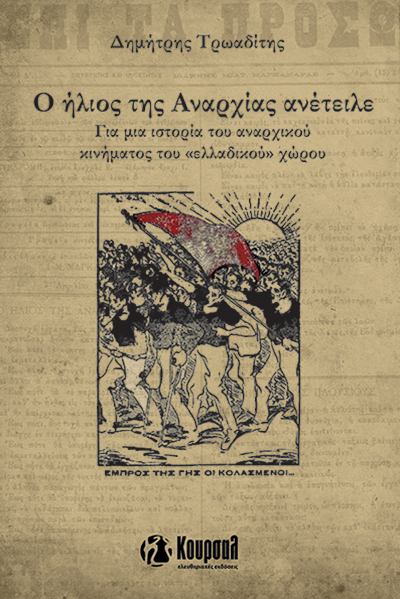
In 1895 he bought from Alexander Eumorfopoulos the newspaper "Epi Ta Proso” (“Forward”), which afterwards became the main organ of spreading the anarchist ideas in Patras and the surrounding area during the second half of 1890. It is also confirmed that before buying "Epi Ta Proso” Magkanaras used writing poems and articles in the socialist newspapers of the time such as “Sosialistis” ("Socialist") of Stavros Kallergis and “Metarrythmistis” (“Reformer”).
Given that only a few issues of the newspaper "Peloponnese" have been survived today we do not know if Magkanaras continued writing for "Peloponnese" simultaneously with his activities with "Epi Ta Proso” and anarchist agitation. Perhaps he continued writing just for living.
In his articles dealt with various social issues of the era, such as working class organizing, women's emancipation, and others. And, of course, he wrote articles about the anarchist ideas.
One of the acquaintances of Giannis Magkanaras was the journalist of "Peloponnese" G. Papalexandropoulos, who was close to the anarchist communist group “Epi Ta Proso”. G. Papalexandropoulos, probably by the help of Giannis Magkanaras published during July-September 1897 (period during which Magkanaras was not a prisoner) the satirical newspaper “Satanas” ("Satan") and later in 1899 (obviously, again with Magkanaras’ help) another satirical newspaper “Mimosa”. Nikos Politis in his "Chronicle of Patras Press 1840-1940” (Patras 1984), writes that "Satanas" had been published regularly every week during July-September 1897 (or maybe and after that time). At least two issues were seized by the authorities. "Mimosa” which appeared in 1899, was the continuation of "Satanas”. This newspaper was against women and men who upheld the rules of...
- Λεπτομέρειες
- Dimitris Troaditis
- English
Dimitris Karampilias born in the village of Mintilogli Achaia (outside of Patras) in 1872. He was one of the most active anarchists in “Epi Ta Proso” newspaper/collective and the anarchist movement of Patras during 1890's. After the dissolution of the anarchist movement of Patras, moved to Athens together with Giannis Magkanaras where they both participated in the anarchist groups and activities.
In 1901, he settled in Alexandria, Egypt, where he worked as a cigarette maker and participated in the labor and anarchist movement, collaborating with Greek and Italian anarchists who had been settled there before him.
We do...
- Λεπτομέρειες
- Dimitris Troaditis
- English
In 1893 Socialistiki Adelfotita (Socialist Brotherhood) founded in Patras, which was not a coherent organisation, but a loose grouping of some socialists and progressives, many of whom were friends and followers of the famous Greek socialist of this time Plato Drakoulis. By some historians, Socialist Brotherhood was allegedly a continuation of the Democratic Club in 1870s.
Brotherhood’s president was Vasilis Doudoumis (a lawyer who among other things, wrote some revolutionary poems), secretary was the teacher Charilaos Dimitropoulos, and one of the leaders of the organisation was the architect Aristotle Thales, who came from Alexandria in Egypt.
Apart from Plato Drakoulis’...
- Greek, Italian and other Anarchists in Egypt - A historical chronicle
- Revolutionary syndicalism and organization
- 1941-1945: Andartiko - the Greek Resistance
- Socialist, anarchist and revolutionary movements in Patras in 1880s
- The Democratic Association of People in Patras and the newspaper “Hellenic Democracy”
- Stavros Kouchtsoglous - A Greek anarchist communist with anarchosyndicalist ideas
- Social radicalism in Greece - Part 1: Reformists - Utopians – Anarchists

Στο κτήριο της Ελληνικής κοινότητας της Μελβούρνης στις 18/07/2019
Με τον Ελευθεριακό στο Αυτοδιαχειριζόμενο Στέκι Πέρασμα, 22/01/2018